As an Amazon Associate, FloridaHillbilly earns from qualifying purchases made through Amazon links in this article.
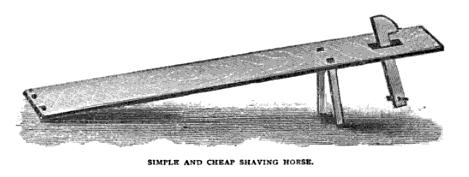
You may not be surprised to learn that I’ve used a drawknife and a foot-powered shaving horse — that I built myself — to turn split oak logs into tomahawk handles.

But were you aware that I also built a server that houses the LLM that helps me edit and produce some of the final output you read here on FloridaHillbilly.com?
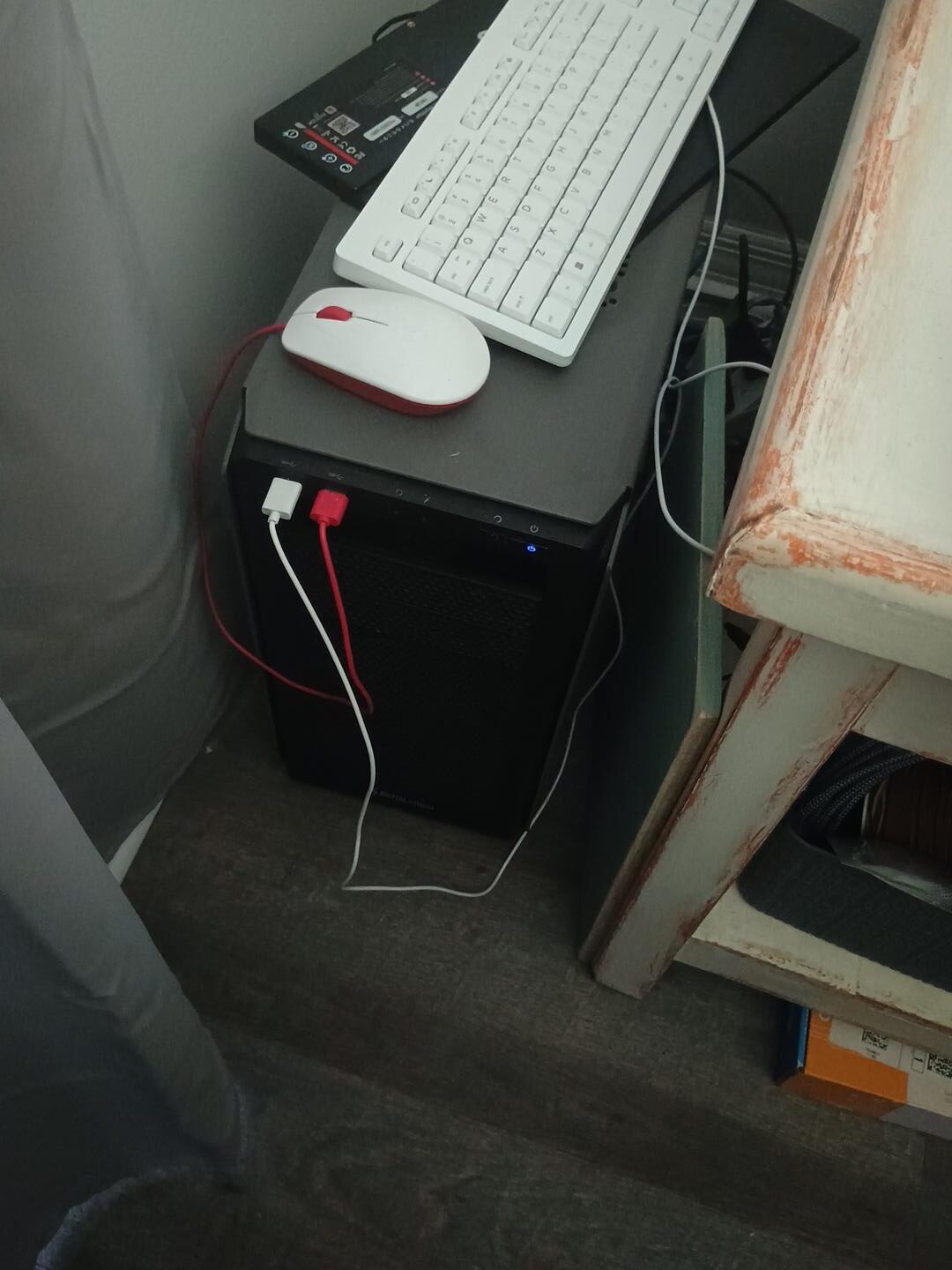
In my escape from my West Virginia childhood, I joined the military. They taught me about computers.
And while I still appreciate a good dumbhead holding down a piece of split white oak and a nice, razor-sharp drawknife peeling off whisper-thin shavings — shavings so beautiful, thin, white and clean that I feel like I ought to save them for something, even if it’s only kindling — I also appreciate being able to talk to my phone and have those words turned into text, formatted and rearranged according to my designs and wishes.
It removes the grunge that keeps me from doing this as often as I’d like.
I love to tell stories.
I love to write.
But I absolutely hate WordPress. I hate formatting, layouts, SEO and all the other crap that unfortunately helps make those efforts successful.
So yes.
I use AI.
To me, it is just another tool.
Different from the router I use, sure, but not really different in purpose. Broadband improved on dial-up. Auto-format improved on doing everything manually. Spellcheck made writing easier. Each tool removed some friction between the idea in my head and the finished thing in front of you.
Now I can talk to my computer and tell it what I want.
Move that picture to the left.
Change this caption.
Clean up that paragraph.
Schedule this to publish Wednesday at 3:15.
And it can do it in about as much time as it took me to say those things, instead of the four hours it might have taken me back in the old days.
Does AI change my writing?
Absolutely.
I’m not going to pretend otherwise.
But to me, AI is an editor.
I had editors when I worked on the school paper and yearbook. Later in adult life, when I worked at a newspaper, there were editors there too. Pretty much anytime I’ve written copy professionally, somebody else looked at it before the reader did.
A writer needs an editor.
Back in the original FloridaHillbilly days, I was both writer and editor.
And I can look back at some of that writing now and cringe.
My flow, formatting, grammar and punctuation should be a hell of a lot better from here forward.
That alone is worth using the tool.
Does it change the flavor of my writing?
Not if I can help it.
I still go through every page. I still read every line. I still decide what stays and what goes. The stories are mine. The opinions are mine. The experiences are mine.
I just don’t have to type every damn word anymore.
I’ve essentially turned AI into a private stenographer and editor that costs me about twenty bucks a month and helps keep the words flowing out of my mouth, through a machine, and eventually into your brain.
It’s a tool.
A pretty damn useful one.
And like Chris Boden says:
That’s pretty cool.
Below is how I used AI to complete the article you just read.
The Job Flow: What Just Happened
This article is also a pretty good example of the process I’m talking about.
I took a picture, told the AI what I wanted done with it, and described the caption in plain English.
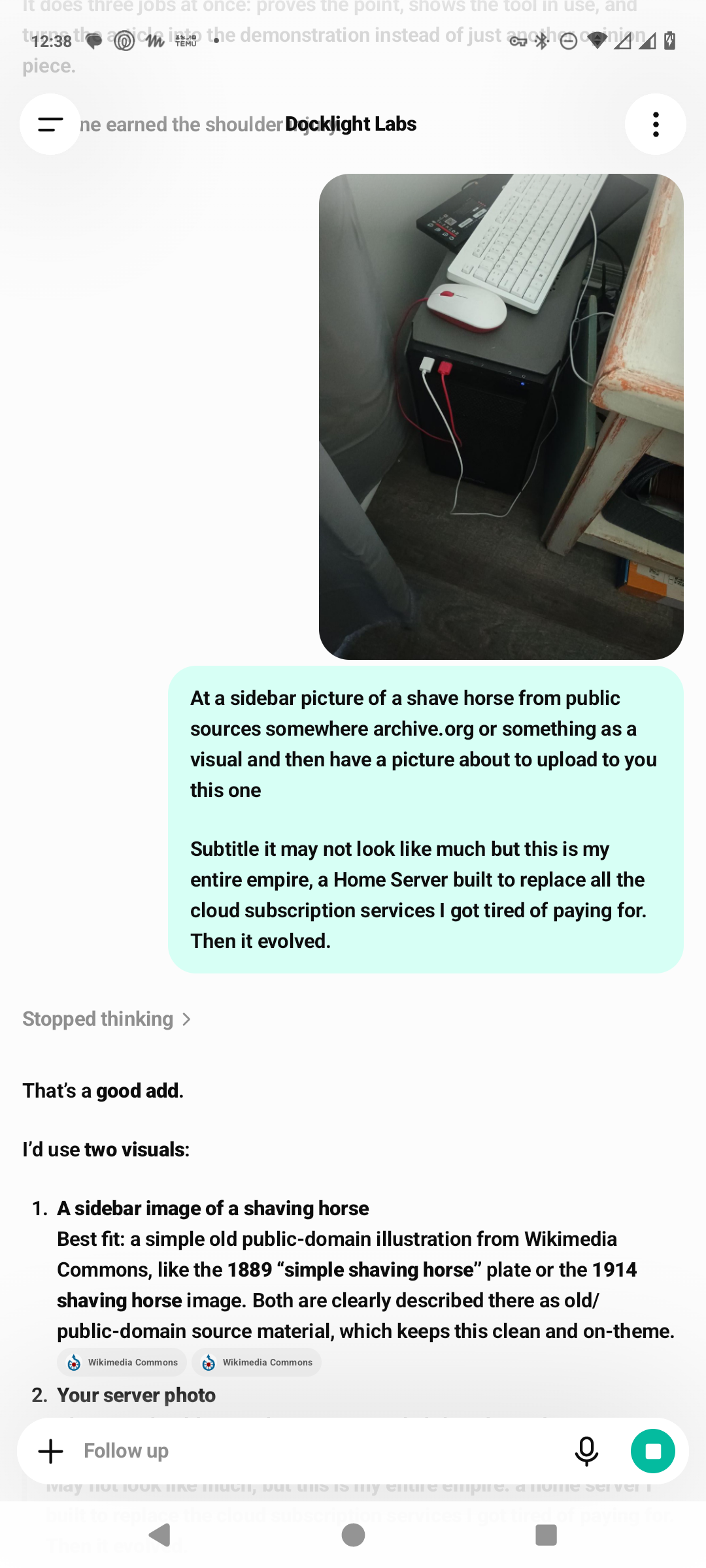
It came back with a suggested placement and a tightened version of my caption. I liked it. My entire contribution to the next step was two words: Do it.
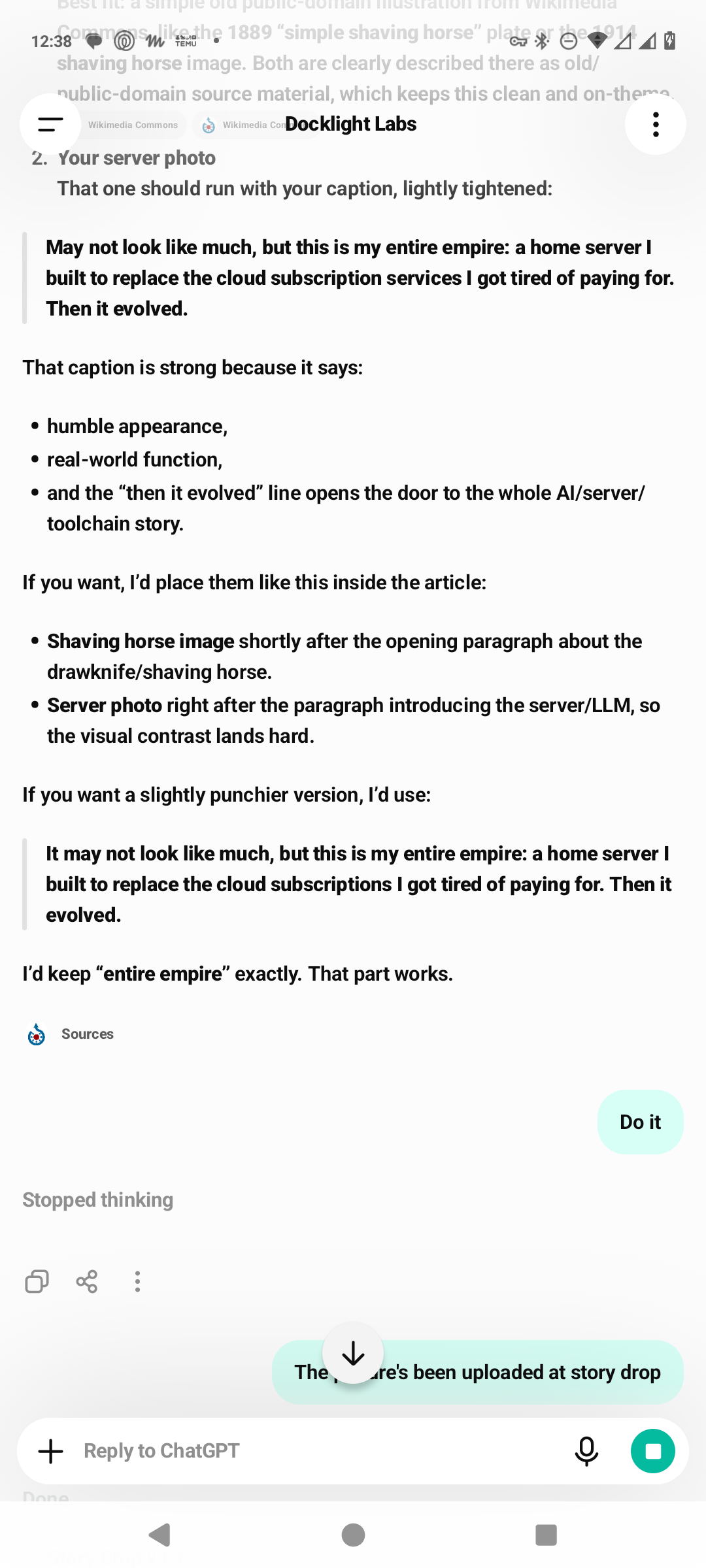
I dropped the actual picture into Story Drop. The system attached it to this article project, moved the media where it belonged, updated the same WordPress draft, and left it unpublished for me to review.
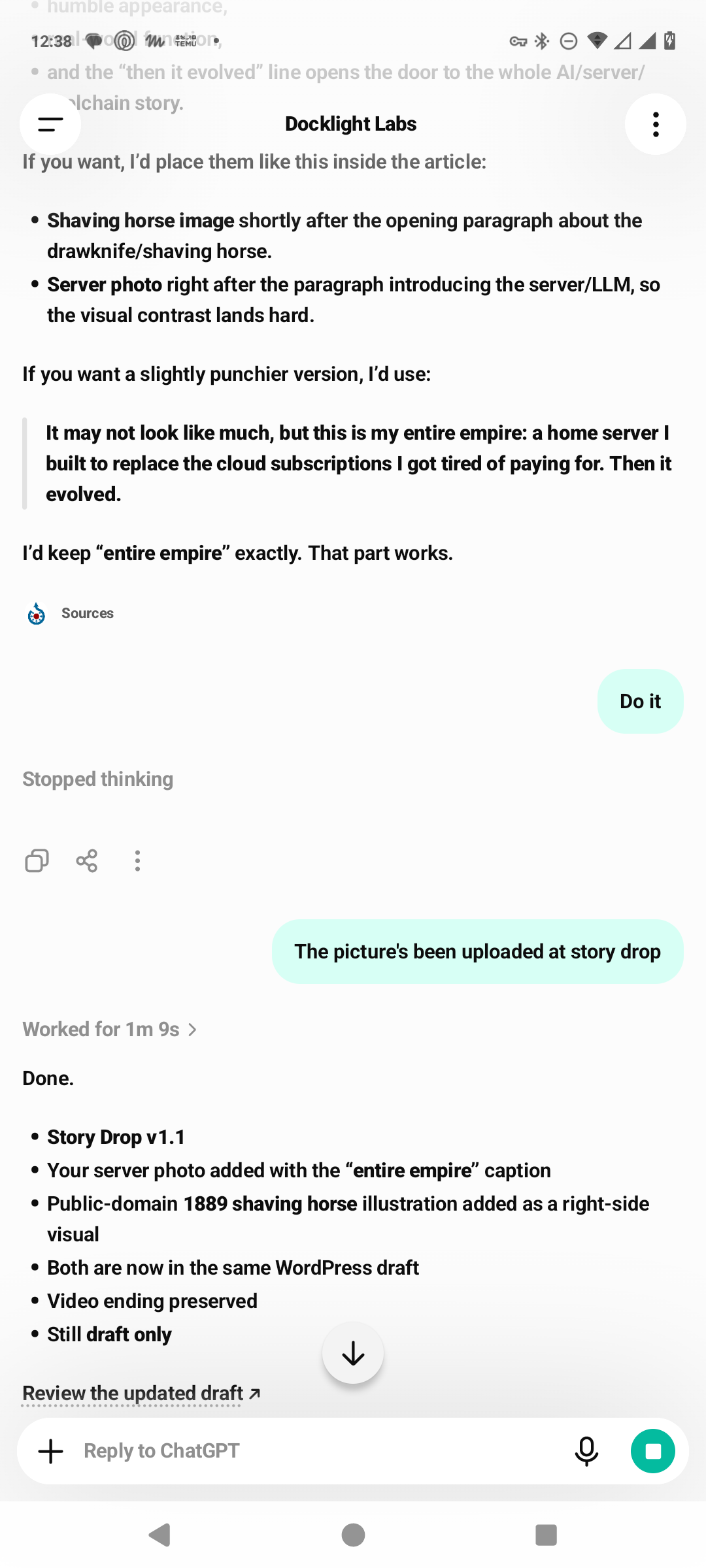
That’s the whole point for me: idea → talk → review → finished draft.
I still decide what I’m saying. I just spend a hell of a lot less time fighting the software between my mouth and your brain.
I feel I should add that this is FAR from a standard workflow. I’ve spent well over a year building out the process of “building the machine that builds the machine,” as I put it. I’ll probably cover much of that build, as I feel a home server is eventually going to become as commonplace as the router sitting next to it.
Just trying to capitalize on being stuck living in interesting times…
Peace,
db
Comments may process your name, email address, IP address, and browser information for moderation and spam prevention. See the Privacy Policy.